

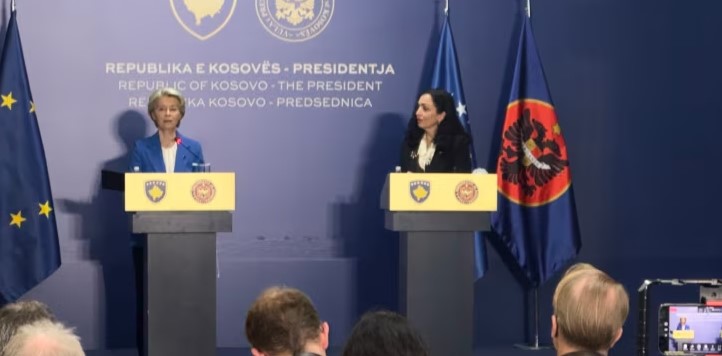
The President of the European Commission, Ursula von der Leyen, said on Saturday in Pristina that the decision of the Kosovo government to lift the ban on imports of goods from Serbia and its progress within the framework of the Agreement on Free Trade in Central Europe can pave the way for the lifting of punitive measures that the European Union imposed on it after last year’s tensions in the north of the country.
“After that, I think we should work on the next steps in order to reach a point where the measures against Kosovo can be lifted. These developments will also help to convince the member countries, because as you know, all countries must agree on such a decision”, she said in a press conference with the President of Kosovo Vjosa Osmani, who said that it is time finally to remove the punitive measures.
“In addition to being unfair, these measures are directly harming the citizens of Kosovo without distinction and have damaged the dialogue process itself, making it completely unbalanced, unequal and without credibility,” she said.
Mrs. Von der Leyen stayed in Kosovo on Saturday as part of a visit to Western Balkan countries aiming for integration, to assure them that the enlargement of the European Union remains a priority of the bloc, especially after the Russian aggression in Ukraine.
Last year the European Union approved a 6 billion euro economic growth plan for the countries of the Western Balkans in an effort to help speed up the integration process.
“Now we can start with the pre-financing of more than 60 million euros that can be given to Kosovo before the end of this year. The realizable value that will be available to Kosovo from the growth plan is more than 882 euros. It is in our hands to carry this plan forward and the first steps are already very promising”, she said.
President Osmani said that Kosovo, being the first country in the Western Balkans to approve sanctions against Russia, has proven its alignment with the values of the European Union while stressing that it is unfortunate for the region that Serbia continues to be, as she said, the main satellite of Russia .
“It is high time that the determination that the European Union has shown in relation to Russia is also shown to the satellites and servants of Russia in our region. This is particularly important regarding Serbia’s responsibility for the act of aggression against Kosovo carried out through terrorist paramilitary forces in September of last year, which according to the White House was intended to destabilize not only Kosovo but the entire Western Balkans,”
she said.
On Friday, Ms Von der Leyen stayed in Belgrade, where she vowed to support Serbia on its path to European integration, while refusing to meet Serbian Prime Minister Miloš Vučević because of his talks on Friday with a high-level delegation. Russian economist, who was in Belgrade to discuss deepening ties with Serbia.
Although officially seeking EU membership, Russia’s traditional ally Serbia has refused to join Western sanctions against Moscow, although it has reluctantly condemned Russian aggression in Ukraine.
Western diplomacy is increasing pressure on Pristina and Belgrade to implement the agreement to normalize relations reached last year in Brussels and Ohrid, amid concerns that Russia may try to destabilize the Western Balkans to divert attention from aggression in Ukraine.
Although it has not been signed, the European Union considers the Ohrid agreement legally binding and in some cases has emphasized that the progress in its implementation is closely related to the progress of both parties in the integration processes.




