

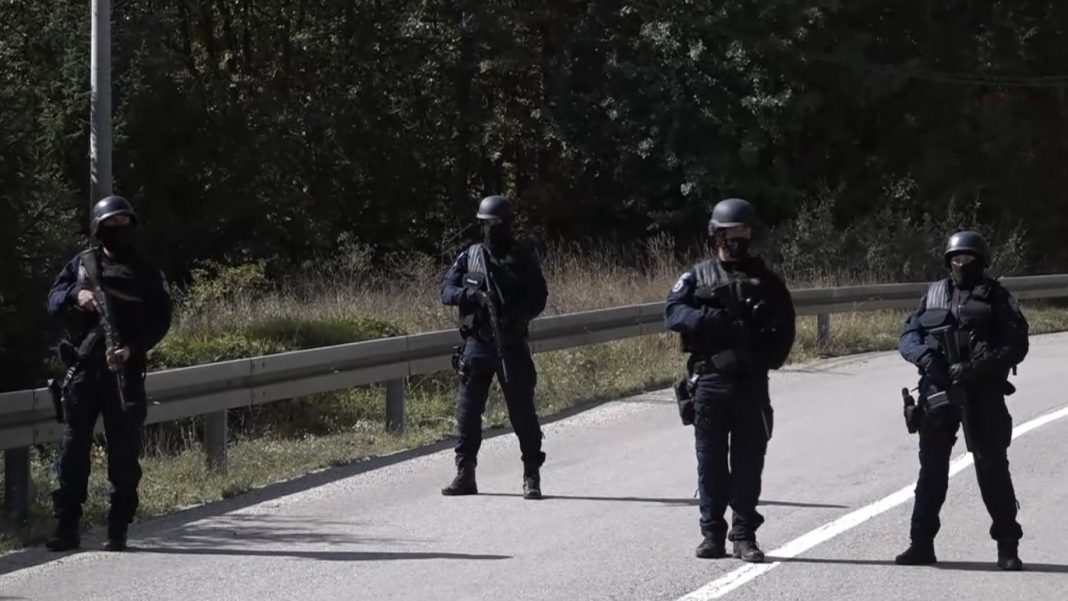
The commander of the peacekeeping mission KFOR in Kosovo, general major Franco Federici, has stated today that the measures undertaken so far in Kosovo, aim to ‘quickly de-escalate tensions’, “reestablish a safe environment and free movement for all communities”.
In a statement for the press, he underscored that KFOR has taken additional steps into the terrain, extending patrols throughout all main roads, where there is currently a presence of barricades.
The units have been scattered across border crossing points in Jarinje and Brnjak.
Since September 20, local Serbs have blocked these two crossing points, that are found in northern Kosovo, immediately after the government of Kosovo announced that they would start implementing the principle of reciprocity on all Serbian license plate holders.
This new policy, requires all Serbian drivers entering Kosovo, to replace their license plates with a temporary set carrying the RKS (Republic of Kosovo) acronym.
It’s worth mentioning, that Serbia has been requiring Kosovo drivers to do the same since 2011, and has nonetheless agreed to Kosovo applying this new policy through the Washington Agreement.
Nevertheless, the situation has escalated and for the past week, there have been protests and back-and-forth comments from the governments of both Kosovo and Serbia.
The EU has made continuous calls for both leaders to lower tensions, and president Vjosa Osmani’s most recent statement on Monday, said that Serbia “is a source for regional destabilization”, while inviting the international community to counter this ‘provocative discourse’ which according to Osmani, doesn’t only have roots in Serbia, but also in Russia.
In addition, tomorrow, Chief Negotiators from both countries will be meeting in Brussels to try and shift the attention back on the dialogue.
YOU MIGHT ALSO LIKE





